Dr. M Hydrolyzed Protein Scalp Tonic
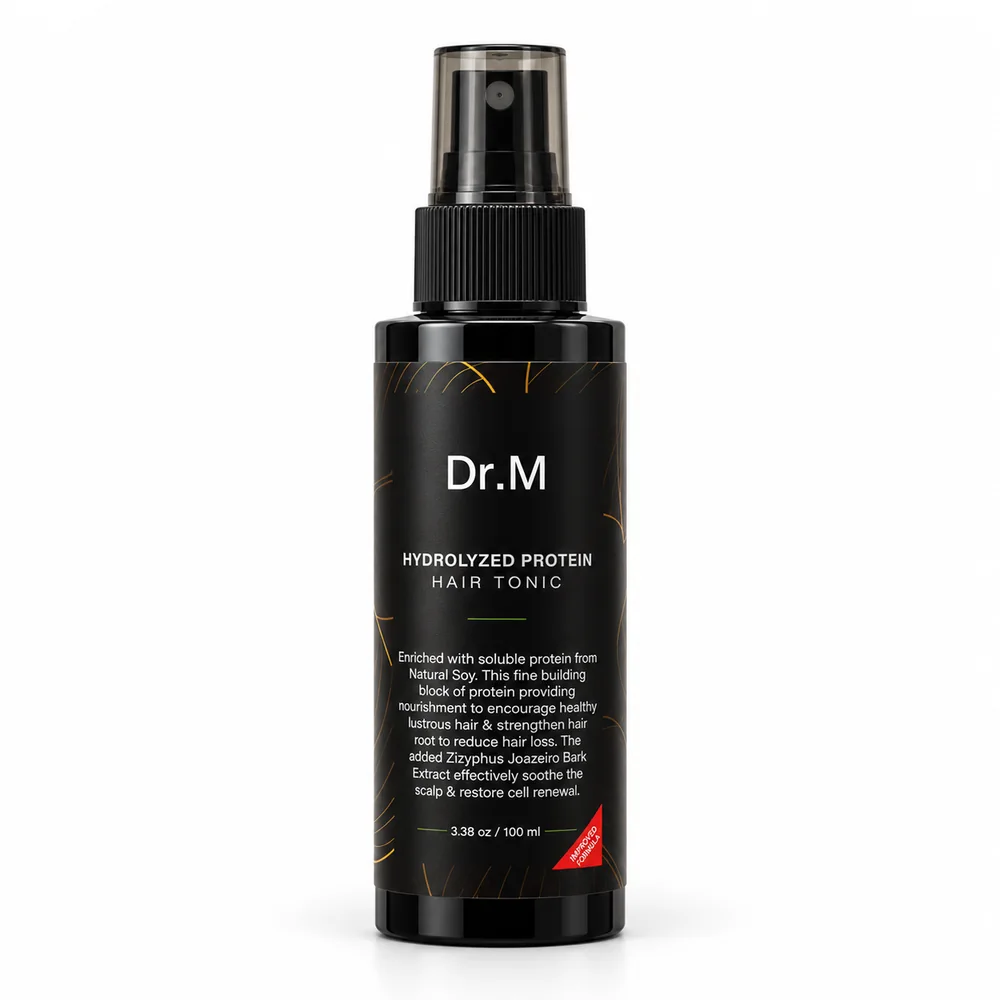
Dr. M Hydrolyzed Protein Hair (Scalp) Tonic, with 18 types of amino acids from hydrolyzed keratin: a light, leave-on tonic that nourishes the scalp and helps hair feel stronger from root to tip, with less breakage when brushing.
- Leave-on tonic
- NOT220105815K
Price RM129 · 3 for RM387, free shipping
Shipping in Malaysia: RM20 West, RM30 East, added at checkout. Bundles of 3 ship free. Malaysia delivery only, no overseas orders.
Overview
Each hair is made mostly of keratin, a tough, fibrous protein, protected by the cuticle: overlapping layers like roof tiles. Hot tools, colouring, rebonding, strong sun, chlorinated pools, rough towel-drying and brushing wet hair all wear the cuticle down, so hair loses strength, tangles and snaps. Those short broken hairs on your brush are usually breakage along the strand.
The tonic’s peptides from hydrolyzed keratin, the same protein hair is made of, are small enough to settle onto the surface of the hair, where they help strands feel smoother and hold up better to styling. No product can mend a split end completely, so trims still matter; the goal is stronger-feeling hair that breaks less.
How to use
- 01
After washing, towel-dry your hair
- 02
Part your hair and apply to the scalp
- 03
Massage for 2–3 minutes
- 04
Leave in. No rinsing
Bundle prices
- 1 bottleRM129
- 3 shampoos (bundle)RM387
- 3 tonics (bundle)RM387
Shipping in Malaysia for single bottles: RM20 West Malaysia (about 5–7 working days) or RM30 East Malaysia (about 10–14 working days), added at checkout. Bundles of 3 ship free.
Order on WhatsAppEvery ingredient, explained
Polypeptides and peptides
Peptides are short chains of amino acids. Some act as messengers that tell cells to build collagen, repair tissue or grow. 'Polypeptide' is a broad term, and effects depend entirely on which peptides are present.
How it works
The best-studied example, GHK-Cu, occurs naturally in human plasma and declines with age; it supports collagen and glycosaminoglycan synthesis and tissue repair1. Copper tripeptides have stimulated dermal papilla cells and reduced markers of their programmed cell death2.
What the evidence shows
The copper tripeptide AHK-Cu stimulated elongation of human hair follicles in organ culture and proliferation of dermal papilla cells2.
In animal work, a copper-binding peptide enlarged hair follicles with an effect similar to topical minoxidil3.
In a 4-month randomised, placebo-controlled trial of 30 volunteers, a topical red clover extract plus biomimetic peptide combination increased anagen and decreased telogen hair density versus placebo4.
Peptides from placenta and caviar also show bioactivity: porcine placenta peptides prolonged anagen in mice5, and sheep placenta peptides showed antioxidant activity6.
Safety and precautions
Reactions depend on the full formula; patch-test first if you have sensitive skin.
Bottom line
Peptides are smart signalling ingredients with encouraging laboratory and early clinical data. Their value depends on the specific peptide, so we will publish the exact peptides once confirmed from the label.
Product knowledge
The hair growth cycle
Each hair follicle is a miniature organ that regenerates itself throughout life, cycling through growth, regression and rest789.
Anagen (growth) · About 2–5 years
Cells in the hair bulb divide rapidly and build the hair shaft. The length of anagen largely determines how long your hair can grow.
Catagen (transition) · About 3–6 weeks
Growth stops and the lower follicle regresses in a tightly controlled process of programmed cell death107.
Telogen (rest) · About 3–5 months
The follicle rests while the old 'club' hair stays anchored.
Shedding and renewal · At the end of telogen
The old hair is released as a new anagen hair begins beneath it. Daily shedding of resting hairs is normal.
What causes hair loss?
Androgenetic alopecia (pattern hair loss)
The most common progressive hair loss in men and women. It is polygenic, with major risk loci on the X chromosome (androgen receptor) and chromosome 2011. In Asian men, smoking has been significantly associated with more severe pattern hair loss12.
Telogen effluvium (excess shedding)
A trigger such as illness, fever, surgery, childbirth, crash dieting, certain medicines or major stress pushes many follicles into telogen at once. Increased shedding typically follows two to four months later1013. Acute telogen effluvium usually resolves; shedding lasting more than six months is called chronic10.
Scalp inflammation and dandruff
Dandruff affects up to half of adults worldwide and involves a weakened scalp barrier, water loss and subclinical inflammation, influenced by sebum and Malassezia yeasts141516. Mild inflammation around follicles is also described in androgenetic alopecia17. Over 20 epidemiological studies link poor scalp condition to poorer hair, and in a treatment study hair quality improved when the scalp was normalised1819.
Oxidative stress
Reactive oxygen species from metabolism, UV, smoking, pollution and scalp inflammation can damage the follicle and the emerging fibre20. Researchers describe oxidative stress as the 'currency' by which an unhealthy scalp harms hair growth and retention2122.
Nutrition
Iron, zinc, vitamin D and other micronutrients are involved in the follicle cycle, and correcting a genuine deficiency matters23. Supplementing without a documented deficiency is less certain, and some supplements in excess can worsen hair loss24.
Sun and environment
UV radiation degrades hair proteins and pigment, weakening the shaft2526. Hair shedding also follows seasonal rhythms; in a Swiss study of 823 women, the proportion of resting hairs peaked in summer27.
How we grade evidence
A · Strong Randomised controlled trials, meta-analyses or official drug labelling in humans.
B · Supportive Smaller, open-label or uncontrolled human studies, or systematic reviews of small trials.
C · Laboratory Cell, ex vivo follicle or animal studies. Important for understanding mechanisms, but not proof of results in people.
R · Background Narrative reviews, safety assessments and case reports.
Frequently asked questions
How long does it take to see a difference in hair loss?
Usually months. Hair grows in cycles in which the growth phase lasts years and the resting phase about 3–5 months10, so changes in density take time. With minoxidil, results may appear from about 2 months, and some people need at least 4.
Is shedding 100 hairs a day normal?
Daily shedding of resting hairs is normal. Clinicians use a standardised hair-wash test, where shedding of more than 100 hairs points towards telogen effluvium10. If you notice a sudden increase, or shedding lasting more than six months, see a doctor.
Does scalp health affect hair growth?
Which hair-loss ingredient has the strongest evidence?
Topical minoxidil.
Further reading
Caviar, Marine Extracts and Peptides: The Ocean's Case for Healthier Hair and Scalp
Caviar has long been a symbol of luxury on the plate. More recently, scientists have become interested in what sturgeon roe and other marine materials can do for skin and hair. Rich in proteins, peptides and omega-3 fatty acids, marine extracts are now among the most researched 'beauty-from-the-sea' ingredients. Here is what the science shows, and how strong that evidence really is.
What is caviar extract?
Caviar is sturgeon roe (fish eggs). Its extracts contain phospholipids, including the omega-3 fatty acid docosahexaenoic acid (DHA), as one of the main components. When caviar is enzyme-treated, its proteins are broken down into mainly low-molecular-weight peptides made of amino acids such as leucine, tyrosine and phenylalanine.
Caviar is used both as a nutritional food and in cosmetic products.
Caviar and skin: the strongest evidence
The most robust caviar study to date is a randomised, double-blind, placebo-controlled clinical trial. Participants taking an oral enzyme-treated caviar extract showed significant improvements in skin hydration, dermal hydration and transepidermal water loss after four weeks, and in skin elasticity after eight weeks.
Laboratory and animal research helps explain why:
- In mice exposed to UVB light, enzyme-treated caviar protected against dehydration, oxidative stress and inflammation. In human skin cells, it increased antioxidant enzyme activity and levels of hyaluronic acid and sphingomyelin, a barrier lipid.
- Caviar extract and its DHA promoted adiponectin production and suppressed MMP-1, an enzyme that breaks down collagen, in skin-cell models.
- Caviar extract showed antioxidant activity and reduced markers of UV-induced photoageing in cells and mice.
For a scalp exposed to tropical sun, antioxidant and hydration support is a sensible goal. But note: these are skin studies, and the human trial used an oral extract.
Caviar and hair: an honest gap
We found no published studies testing caviar extract directly on human hair growth. The closest evidence comes from related marine ingredients:
- Fish-derived DHA. Fermented mackerel fish oil and its omega-3 DHA increased dermal papilla cell proliferation and promoted entry into anagen, the growth phase, in follicle and mouse models. Caviar is also a source of DHA, but this was not a caviar study.
- Oral marine-protein supplements. In a 90-day randomised, placebo-controlled trial of 60 women with self-perceived thinning hair, an oral marine-protein supplement significantly increased terminal hairs and reduced shedding compared with placebo. In another randomised trial of 96 premenopausal women, a marine-extract supplement significantly reduced shedding over three to six months and increased the diameter of fine, vellus-like hairs at six months.
These trials are encouraging for marine-derived nutrition in general. They are not evidence for any specific topical caviar product, and we will not pretend otherwise.
Peptides: small proteins with big signalling roles
Peptides are short chains of amino acids. Some act as messengers that tell cells what to do, which is why they are widely used in skincare.
- Copper peptides. GHK, a copper-binding peptide naturally present in human plasma, declines with age. Research describes it supporting skin repair, collagen and glycosaminoglycan synthesis, and wound healing, including of hair follicles in animal studies.
- Direct follicle effects. The tripeptide-copper complex AHK-Cu stimulated elongation of human hair follicles grown in the lab and the proliferation of dermal papilla cells. A copper-binding peptide enlarged hair follicles in rats, with an effect similar to topical minoxidil in that model.
- A small human trial. In a randomised, placebo-controlled trial of 30 volunteers, a topical combination of red clover extract and a biomimetic peptide increased anagen hair density and decreased telogen hair density over four months compared with placebo.
Peptide research is promising, but results depend on the specific peptide, its concentration and its delivery. 'Peptides' on a label does not tell you which ones.
How to read marine beauty claims
Marine ingredients are often marketed with sweeping promises. A few questions keep things honest:
- Oral or topical? The strongest caviar and marine-protein trials tested supplements that were swallowed. A topical product works through a different route.
- Skin or hair? Caviar's human evidence is for skin hydration and elasticity, not hair growth.
- Which peptide? Copper peptides such as AHK-Cu have follicle data; that does not mean every peptide does.
- What kind of study? A randomised, placebo-controlled trial in people counts for more than a cell or mouse study, however impressive the mechanism.
Allergy and safety
Marine ingredients are natural, but natural does not mean allergy-free.
- Fish roe allergy is real. Two people were reported with IgE-mediated allergy to fish roe, one with anaphylaxis, without having a general fish allergy. A case of anaphylaxis to Beluga caviar has also been reported.
- What this means for you: if you have ever reacted to fish, seafood or fish roe, tell your adviser before using a caviar-containing product, and stop if you notice itching, swelling or a rash.
Where Folli fits
The research above was not conducted on Folli-Fuel. We include caviar and peptides for their skin-hydration and antioxidant research, and we are clear that direct hair studies on caviar do not yet exist.
Is caviar good for hair?
It has not been tested directly on hair growth. Caviar extract improved skin hydration and elasticity in a randomised oral trial and showed antioxidant effects in the lab, but no human hair studies exist yet.
Do marine protein supplements help thinning hair?
Clinical trials suggest they can. Two randomised, placebo-controlled trials in women found more terminal hairs or thicker fine hairs and reduced shedding.
What do peptides do for the scalp?
Some act as cell messengers. Copper peptides support skin repair and stimulated human hair follicle elongation in the lab.
Can I use caviar products if I have a seafood allergy?
Talk to your doctor first. Fish roe allergy, including anaphylaxis, has been reported even in people without a general fish allergy.
Why is omega-3 DHA linked to hair?
In laboratory and mouse studies, fish-oil DHA increased dermal papilla cell proliferation and promoted the growth phase. Human evidence is still limited.
Are marine ingredients better than plant ingredients for hair?
Not necessarily. Evidence depends on the specific ingredient and study, not on its source; each should be judged on its own research.
How to Build a Scalp Care Routine That Actually Supports Your Hair
Great hair starts at the scalp. Yet most routines are designed around the hair shaft: shampoo, conditioner, styling. A scalp care routine flips the focus to the skin your hair grows from. The good news is that it does not need to be complicated. It needs to be consistent, matched to your goals, and based on what research actually supports.
Why the scalp matters
The scalp is skin with an unusually dense population of hair follicles. When it is irritated, flaky or inflamed, hair suffers. Over 20 epidemiological studies associate abnormal scalp conditions with impaired hair, and a treatment study showed those effects on hair were reversible once the scalp was normalised. Scientists describe oxidative stress as the mechanism linking an unhealthy scalp to poorer hair growth and retention.
So a scalp routine is not a luxury. It is the foundation.
Step 1: Know your goal
Before choosing products, decide what you are trying to achieve:
- Comfort and hydration: dryness, tightness, itch or sensitivity.
- Balance: oiliness, flaking or dandruff.
- Thinning or pattern hair loss: a gradual reduction in density, a widening part or a receding hairline.
- Excess shedding: sudden, diffuse hair fall, often two to four months after a trigger such as illness, childbirth or major stress.
Sudden patchy loss, scarring, pain or significant redness are reasons to see a doctor first.
Step 2: Cleanse often enough
Many people under-wash because they fear washing will make hair fall out. Research says otherwise. In a study of Asian populations, washing five to six times a week gave the best overall scalp and hair satisfaction, and daily washing outperformed weekly washing with no detrimental effects.
Hairs released during washing are mostly resting (telogen) hairs that had already reached the end of their cycle; clinicians even count them in a standardised hair-wash test.
If you have dandruff, use an anti-dandruff shampoo. Dandruff is linked to Malassezia yeasts and responds to treatments that inhibit them, and improving dandruff has been shown to reduce scalp oxidative stress and improve the quality of hair grown afterwards.
Step 3: Hydrate the scalp, not just the hair
Conditioners are formulated for the hair shaft. The scalp needs its own lightweight hydration. Hyaluronic acid is a well-tolerated, hygroscopic ingredient supported by multiple clinical studies for skin hydration, which makes it a natural choice for a scalp hydrator.
Apply hydrating products to clean, dry scalp, section by section, and massage in.
Step 4: Add a targeted treatment for thinning
A meta-analysis of randomised trials found it superior to placebo in both sexes.
To get the most from a minoxidil product:
- Apply to a dry scalp, directly on thinning areas, then wash your hands.
- Be consistent. Results may take two months, and some people need four months or longer.
- Expect possible early shedding. A temporary increase in shedding can occur in the first weeks and is not a reason to stop.
- Keep going. Continued use is needed to keep results.
- Know when to pause. Stop and see a doctor if you experience chest pain, rapid heartbeat, dizziness, swelling or persistent scalp irritation. Do not use it if you are pregnant or breastfeeding.
Step 5: Layer products in the right order
A simple layering principle: treatment first, on a dry scalp; hydration and styling after it has absorbed. If you use a minoxidil product and a scalp gel, apply them at different times of day if possible, or follow your product instructions carefully so each one can do its job.
Step 6: Massage
Massage helps distribute products and is a pleasant habit. In a small study of nine healthy men, four minutes of standardised scalp massage daily for 24 weeks was associated with increased hair thickness. These are small or self-reported studies, so think of massage as a supporting habit, not a treatment.
Step 7: Protect against the sun
UV radiation is the most frequent cause of structural damage to the hair shaft: UVB degrades hair proteins and UVA changes colour. Solar radiation can reduce hair strength, lustre and protein content. A hat or shade during the strongest midday sun protects both scalp and hair.
Step 8: Support from within
Hair is built from what you eat. Iron, zinc, vitamin D and B vitamins all play roles in the hair follicle cycle, and deficiency may be a modifiable risk factor for hair loss. If you suspect a deficiency, ask your doctor for a blood test before supplementing.
Be cautious with megadoses. Supplements without a documented deficiency have unproven benefit, and some may worsen hair loss. Biotin is a good example: reported benefits occur in people with an underlying deficiency, and high-dose biotin can distort common blood tests, including thyroid tests. Tell your doctor if you take it.
Lifestyle matters too. In a population study of Asian men, smoking was significantly associated with more severe pattern hair loss.
Track progress the smart way
Hair grows in cycles that span months to years, so daily mirror checks will only frustrate you. Take photos in the same light, from the same angles, once a month. Judge a hair-loss treatment after at least four months of consistent use.
Where Folli fits
Folli-Fix (foam, for men and women) and Folli-Fix X10 (liquid, for adult men) are our minoxidil treatments; use one or the other on a given area, not both. Folli-Care is our hyaluronic-acid scalp hydrator. Folli-Fuel is a professional in-centre treatment delivered by our experienced team. Ask us to help you choose a routine that suits your scalp and goals.
How often should I wash my scalp?
Most people can wash often. Among Asian participants, five to six washes a week gave the best results, and daily washing outperformed weekly washing.
Does washing hair every day cause hair loss?
No. Daily washing showed no detrimental effects in a study of Asian populations, and hairs shed while washing are mostly resting hairs at the end of their cycle.
Should I apply minoxidil to a wet or dry scalp?
Dry. Apply minoxidil to a dry scalp on the thinning areas and wash your hands afterwards, as product directions advise.
Can I use a scalp serum with minoxidil?
Usually, yes, with good timing. Apply the minoxidil treatment to a dry scalp first, let it absorb, and follow each product's directions.
Does scalp massage help hair growth?
It may help a little. Small studies linked daily massage to thicker hair, but they were small or self-reported.
How long before a scalp routine shows results?
Comfort improves quickly; hair takes months. For minoxidil, results may take two to four months or more.
Do I need supplements for healthy hair?
Only if you are deficient. Correcting a deficiency matters, but supplementing without one has unproven benefit.
The Hair Growth Cycle Explained: Anagen, Catagen and Telogen
Finding hair on your pillow can be unsettling. But shedding is a normal part of how hair works. Each follicle on your scalp runs its own cycle of growth, rest and renewal. Understanding that cycle is the single most useful thing you can learn about hair, because it explains why hair falls, why it thins and why any genuine improvement takes months.
The follicle: a mini-organ that regenerates itself
A hair follicle is not a passive tube. It is a miniature organ that rebuilds itself again and again throughout life, cycling through phases of growth, regression and rest. Its behaviour is controlled by signalling families with names like Wnt, FGF, TGF-β and Sonic hedgehog, which tell the follicle when to grow and when to stop.
At the base of the follicle sits the dermal papilla, a cluster of specialised cells that acts as the control centre. Many hair-care studies, including research on minoxidil, placenta extracts and botanicals, measure effects on dermal papilla cells for this reason.
Phase 1: Anagen, the growth phase
Anagen is when the hair is actively made. Cells at the base of the follicle divide rapidly, building the hair shaft upwards.
The length of anagen largely decides how long your hair can grow. It is also the phase most affected by pattern hair loss, where anagen becomes progressively shorter.
Phase 2: Catagen, the transition
When anagen ends, the follicle enters catagen. Growth stops and the lower part of the follicle regresses through a tightly controlled process of programmed cell death. Catagen lasts about three to six weeks.
Phase 3: Telogen, the resting phase
In telogen, the follicle rests. The old hair, now called a club hair, stays anchored while the follicle prepares for a new cycle.
Shedding and renewal
At the end of telogen, the old club hair is released as a new anagen hair starts to grow beneath it. This is normal shedding. Because every follicle runs on its own schedule, you shed some hairs every day without your overall density changing.
When clinicians want to measure shedding objectively, they can use a standardised hair-wash test; shedding of more than 100 hairs in that test points towards telogen effluvium.
When the cycle goes wrong
Most hair loss is, at heart, a disruption of the hair cycle. The two most common patterns work in very different ways.
Androgenetic alopecia: a shrinking cycle
With each cycle, anagen gets shorter and telogen relatively longer, so the hair produced becomes shorter and finer. The condition is polygenic, involving many genes, with major contributions from the androgen receptor gene on the X chromosome and a region on chromosome 20. Low-grade inflammation around the follicle has also been described.
This is why pattern hair loss tends to look like gradual thinning rather than sudden shedding.
Telogen effluvium: a synchronised rest
In telogen effluvium, a trigger such as a high fever, illness, surgery, childbirth, crash dieting, certain medicines or major stress pushes a large number of follicles into telogen at the same time. Because telogen lasts months, the extra shedding appears later, typically two to four months after the trigger.
Acute telogen effluvium usually settles once the trigger is removed. Shedding that lasts more than six months is described as chronic. Telogen effluvium can also occur alongside androgenetic alopecia.
Seasons, scalp and lifestyle
The cycle is also influenced by things around it.
- Seasons. In a Swiss study of 823 healthy women, the proportion of resting hairs followed an annual rhythm and peaked in summer.
- Scalp health. Over 20 epidemiological studies link poor scalp condition, such as dandruff, to impaired hair, and in a treatment study the effects on hair were reversed when scalp condition was normalised.
- Oxidative stress. Reactive oxygen species from UV, smoking, pollution and scalp inflammation can affect the follicle and hair fibre.
- Nutrition. Iron, zinc, vitamin D and B vitamins all play roles in the follicle cycle, and genuine deficiency may be a modifiable risk factor for hair loss.
How treatments act on the cycle
The best-studied topical, minoxidil, works directly on the cycle: in animal studies it shortens telogen so resting follicles re-enter anagen earlier, and it may prolong anagen and enlarge follicles. This also explains the temporary shedding some people notice when they start: old resting hairs are released as new growth begins.
Other ingredients, from placenta extracts to green tea catechins, have been studied for effects on the dermal papilla and the timing of anagen, mostly in laboratory and animal research so far. These are interesting leads, but they are not equivalent to clinical proof in people.
Why patience is a scientific necessity
Put the numbers together: anagen lasts years, telogen lasts three to five months, and changes in the cycle take time to become visible. That is why reputable treatments describe results in months, not days. With minoxidil, for example, labelling states that results may appear from two months and some men need at least four months.
When to see a doctor
See a doctor if hair loss is sudden, patchy, painful, accompanied by scalp redness or scarring, or comes with other symptoms such as fatigue or weight change. These can signal conditions that need medical assessment, including nutritional deficiencies.
What are the three phases of hair growth?
Anagen (growth), catagen (transition) and telogen (rest). On the scalp, anagen lasts about two to five years, catagen three to six weeks and telogen three to five months.
Why does hair loss show up months after a stressful event?
Because of the length of telogen. A trigger pushes follicles into the resting phase, and the extra shedding appears about two to four months later.
Does pattern hair loss make hair fall out faster?
Not mainly. Pattern hair loss shortens the growth phase and miniaturises follicles, so hairs become progressively shorter and finer.
Is shedding more in summer normal?
It can be. A Swiss study of 823 women found the proportion of resting hairs peaked in summer.
Can you speed up the hair growth cycle?
Some treatments can influence it. Minoxidil shortens telogen in animal studies and may prolong anagen, but changes still take months to see.
Research references
- Pickart L et al. GHK Peptide as a Natural Modulator of Multiple Cellular Pathways in Skin Regeneration. BioMed research international 2015. Link
- Pyo HK et al. The effect of tripeptide-copper complex on human hair growth in vitro. Archives of pharmacal research 2007. Link
- Uno H et al. Chemical agents and peptides affect hair growth. The Journal of investigative dermatology 1993. Link
- Loing E et al. A new strategy to modulate alopecia using a combination of two specific and unique ingredients. Journal of cosmetic science 2013. Link
- Lee C et al. Low molecular weight porcine placenta peptide (Placenderm®) as a functional ingredient for hair health: evidence from in vitro and in vivo studies. Food science and biotechnology 2025. Link
- Wali A et al. Antioxidant peptides of sheep placental extract digestion product: In vitro and in silico study. Biochemical and biophysical research communications 2025. Link
- Schneider MR et al. The hair follicle as a dynamic miniorgan. Current biology : CB 2009. Link
- Stenn KS et al. Controls of hair follicle cycling. Physiological reviews 2001. Link
- Paus R et al. The biology of hair follicles. The New England journal of medicine 1999. Link
- Asghar F et al. Telogen Effluvium: A Review of the Literature. Cureus 2020. Link
- Lolli F et al. Androgenetic alopecia: a review. Endocrine 2017. Link
- Su LH et al. Association of androgenetic alopecia with smoking and its prevalence among Asian men: a community-based survey. Archives of dermatology 2007. Link
- Rebora A Telogen effluvium: a comprehensive review. Clinical, cosmetic and investigational dermatology 2019. Link
- Turner GA et al. Stratum corneum dysfunction in dandruff. International journal of cosmetic science 2012. Link
- Borda LJ et al. Seborrheic Dermatitis and Dandruff: A Comprehensive Review. Journal of clinical and investigative dermatology 2015. Link
- Hay RJ Malassezia, dandruff and seborrhoeic dermatitis: an overview. The British journal of dermatology 2011. Link
- Mahé YF et al. Androgenetic alopecia and microinflammation. International journal of dermatology 2000. Link
- Tosti A et al. Role of scalp health in achieving optimal hair growth and retention. International journal of cosmetic science 2021. Link
- Schwartz JR et al. The role of oxidative damage in poor scalp health: ramifications to causality and associated hair growth. International journal of cosmetic science 2015. Link
- Trüeb RM The impact of oxidative stress on hair. International journal of cosmetic science 2015. Link
- Trüeb RM Oxidative stress and its impact on skin, scalp and hair. International journal of cosmetic science 2021. Link
- Trüeb RM et al. Scalp Condition Impacts Hair Growth and Retention via Oxidative Stress. International journal of trichology 2018. Link
- Almohanna HM et al. The Role of Vitamins and Minerals in Hair Loss: A Review. Dermatology and therapy 2019. Link
- Guo EL et al. Diet and hair loss: effects of nutrient deficiency and supplement use. Dermatology practical & conceptual 2017. Link
- Sebetić K et al. UV damage of the hair. Collegium antropologicum 2008. Link
- Dario MF et al. Effects of solar radiation on hair and photoprotection. Journal of photochemistry and photobiology. B, Biology 2015. Link
- Kunz M et al. Seasonality of hair shedding in healthy women complaining of hair loss. Dermatology (Basel, Switzerland) 2009. Link
- Drake L et al. Evaluation of the Safety and Effectiveness of Nutritional Supplements for Treating Hair Loss: A Systematic Review. JAMA dermatology 2023. Link
- Patel DP et al. A Review of the Use of Biotin for Hair Loss. Skin appendage disorders 2017. Link
Videos
Photos
Research
These are studies on ingredients or general approaches, summarised with their limits. None of them tested this treatment or product, and they don’t prove what it will do for you.
- Koyama T et al. Standardized scalp massage results in increased hair thickness by inducing stretching forces to dermal papilla cells in the subcutaneous tissue. Eplasty 2016;16:e8.Small uncontrolled study (9 men). Daily scalp massage for 24 weeks was linked with thicker hair in nine men. Very weak evidence.PubMed 26904154
- Almohanna HM et al. (2019). The Role of Vitamins and Minerals in Hair Loss: A Review. Dermatol Ther (Heidelb) 9(1):51-70.Review. Micronutrients such as iron, zinc, vitamin D and B vitamins play roles in the hair follicle cycle; deficiency may be a modifiable risk factor for hair loss.PubMed 30547302doi:10.1007/s13555-018-0278-6
FAQ
Can I mix shampoo and tonic in a bundle?
Yes. Bundle prices apply to any mix of the two, from 2 to 5 bottles.
What does the notification number mean?
Both are notified cosmetics in Malaysia. Notification is not an endorsement of any claim.
Is Dr. M a treatment for hair loss?
No. It is a cosmetic hair-care routine. If your scalp is sore, very itchy, red or flaking heavily, please see a qualified health professional.
Wrong item delivered?
Tell us within 7 days and we will sort it out.
Start with a scalp check
Tell us a little about your hair. The form opens WhatsApp with your details filled in, ready to send to Dr Steven’s team.
- Your scalp is checked before anything is recommended
- Full price is explained before you decide, with no obligation
- We serve you in English, 中文 or Bahasa Melayu
Prefer to message directly? WhatsApp 012-334 4983