Dr. M Hokkaido Kelp Shampoo
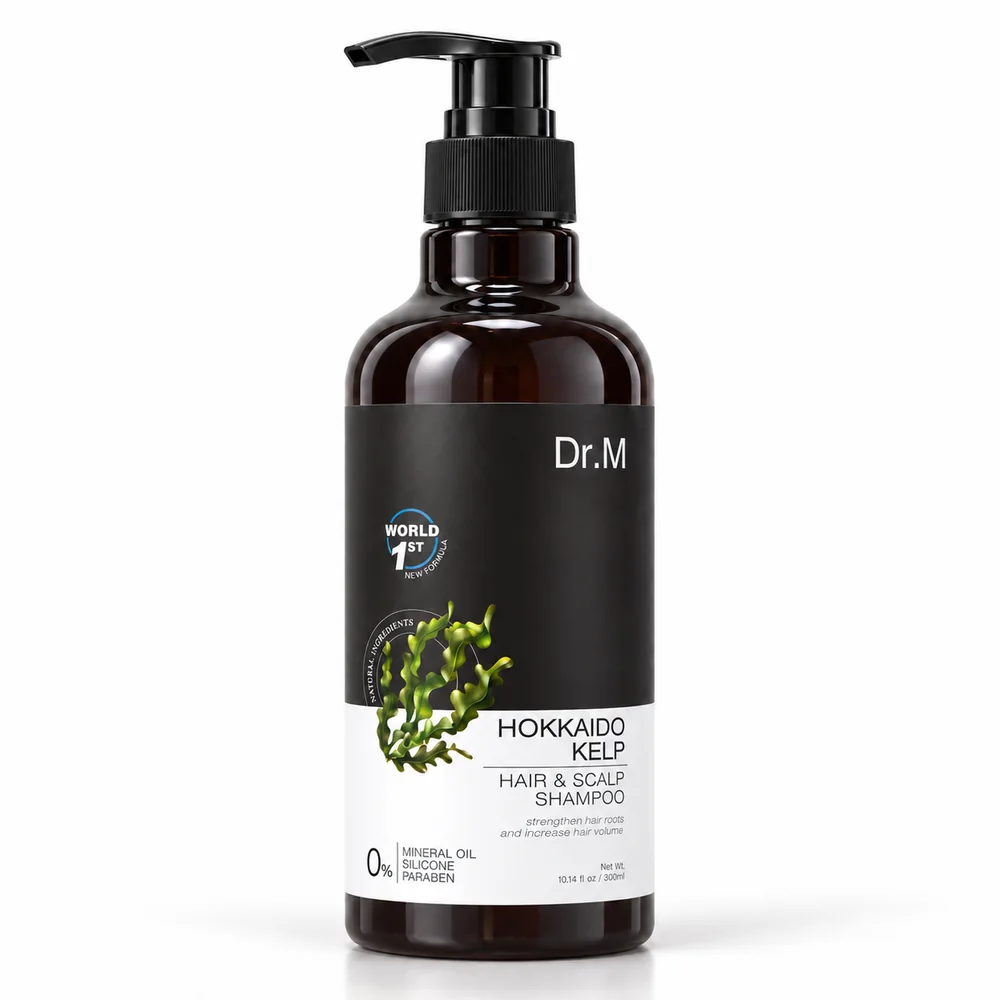
Dr. M Hokkaido Kelp Hair & Scalp Shampoo cleanses excess oil and build-up with Hokkaido kelp extract, in a low-SLS formula made for daily washing in a hot, humid climate.
- Shampoo
- NOT220504152K
Price RM129 · 3 for RM387, free shipping
Shipping in Malaysia: RM20 West, RM30 East, added at checkout. Bundles of 3 ship free. Malaysia delivery only, no overseas orders.
Overview
The kelp in Dr. M Hokkaido Kelp Shampoo is sourced from Hokkaido, Japan’s northernmost main island, where cold, nutrient-rich currents produce some of the country’s most prized kombu. Kelp brings marine minerals and alginate, its natural polysaccharide, for a fresh, never-stripped feel.
It is made with our manufacturer’s patented kelp extraction technology, and it is free from mineral oil, silicone and parabens, so nothing heavy is left on the roots. That matters in Malaysia, where heat, sweat and humidity spread oil fast and make hair cling to the scalp.
Wash as often as your scalp needs. For oily scalps that is often daily. Massage the lather over the whole scalp, not just the lengths, because oil sits at the roots, and rinse with lukewarm rather than hot water.
How to use
- 01
Wet hair and scalp thoroughly
- 02
Massage the lather over the whole scalp
- 03
Leave the lather on for 2–3 minutes
- 04
Rinse well with lukewarm water
Bundle prices
- 1 bottleRM129
- 3 shampoos (bundle)RM387
- 3 tonics (bundle)RM387
Shipping in Malaysia for single bottles: RM20 West Malaysia (about 5–7 working days) or RM30 East Malaysia (about 10–14 working days), added at checkout. Bundles of 3 ship free.
Order on WhatsAppFrom the original site
Thinning-looking hair? Stronger-feeling. Fuller-looking.
More strands in your brush? An 18-peptide everyday Scalp Tonic for less breakage when brushing, plus Hokkaido kelp shampoo. One simple 2-step routine.
Hokkaido Kelp ShampooDeep, clean, fresh
Everyday Scalp Tonic18 amino peptides
海 の 恵 み
Dr. M pairs a Hokkaido kelp shampoo, made with our manufacturer’s patented kelp extraction technology, with a Scalp Tonic of 18 amino peptides from hydrolyzed keratin. Less oil and build-up at the roots; hair that feels stronger from root to tip and looks fuller, with fewer broken strands in your brush.
Pay by cardShop bundles
Dr. M Hokkaido Kelp shampoo
- JPHokkaido kelpSourced from Hokkaido, Japan
- ◆Patented extractionOur manufacturer’s kelp technology
- 1818 amino peptidesFrom hydrolyzed keratin
Dr. M in one minute
Source: drmhaircare.com
Everything you need to know, at a glance.
What it is
A two-step hair and scalp routine from Dr. M Hair Care, a Malaysian brand: Dr. M Hokkaido Kelp Shampoo and Dr. M Hydrolyzed Protein Scalp Tonic.
The Scalp Tonic
A leave-on spray with 18 types of amino peptides from hydrolyzed keratin. Nourishes the scalp, helps hair feel stronger from root to tip and reduces breakage.
Source: drmhaircare.com
Most “bad hair days” start with two things: a scalp carrying too much…
Most “bad hair days” start with two things: a scalp carrying too much oil and build-up, and strands that have lost their strength. Dr. M takes care of both.
Oily by mid-afternoon?
Kelp minerals and a thorough lather lift away excess oil, so your scalp feels fresh and your roots feel light, not greasy.
Visible build-up at the roots?
A deep yet gentle cleanse clears styling product, sweat and city grime that leave the scalp looking dull and the roots looking heavy.
Scalp feels heavy by evening?
Once residue is properly washed away, the scalp simply feels cleaner, lighter and more comfortable through a long, humid day.
Thinning-looking or weak, brittle hair?
18 keratin peptides nourish the scalp and help hair feel stronger from root to tip and look fuller, with less breakage when you brush — fewer broken strands in your brush.
Rough, frayed ends?
Peptides from hydrolyzed keratin settle onto the hair surface, so strands feel smoother and hold up better to styling.
Flat, limp or dull hair?
No silicone in the shampoo to weigh strands down. Clean roots plus stronger-feeling strands give more lift, a fuller-looking finish and natural shine.
The Dr. M duo
Why it happens, and what helps
- Wash as often as your scalp needs. For oily scalps in Malaysia that is often daily, so choose a shampoo made for daily washing.
- Massage the lather over the whole scalp, not just the lengths. Oil sits at the roots.
- Rinse thoroughly with lukewarm rather than hot water.
- Avoid heavy oils and silicones on the roots; keep conditioners and serums to the mid-lengths and ends.
What is “build-up”, and why does it make hair look dull?
Build-up is the layer of everything that collects on the scalp and roots between washes: leftover styling products, dry shampoo, heavy conditioners, silicones, sunscreen, sweat, natural oil and the fine dust of city life. On its own, each of these is harmless. Together, over days, they form a film.
That film makes the scalp look dull and the roots look flat and greasy. It can also leave the scalp feeling heavy or stuffy, especially under a helmet or a tudung, or after a day outdoors.
- A shampoo that cleanses thoroughly without relying on silicones to make hair feel smooth afterwards.
- Two rounds of shampoo if you use a lot of styling products: the first lifts products, the second cleanses the scalp.
- Letting the lather sit for 2–3 minutes so it can work on residue, instead of rinsing straight away.
- Washing brushes and pillowcases regularly, since they collect the same residue.
Where Dr. M fits: the Hokkaido Kelp Shampoo is designed for a deep, clean, fresh feel. Our how-to asks you to leave the lather on for 2–3 minutes for exactly this reason.
Why does my scalp feel heavy and uncomfortable by the end of the day?
A scalp that feels heavy, warm or stuffy by evening is usually a sign of too much oil, sweat and residue sitting at the roots, especially in humid weather or under a helmet, cap or tudung. Hair that has been flattened all day also traps warmth against the scalp.
- Keeping heavy products away from the scalp.
Where Dr. M fits: clean roots simply feel lighter. The Hokkaido Kelp Shampoo removes excess oil and build-up so the scalp feels fresh; the light, leave-on Scalp Tonic then goes on the clean scalp without adding heaviness.
If your scalp is sore, very itchy, red or flaking heavily, or if anything worries you, please see a qualified health professional. Dr. M is a cosmetic hair-care routine, not a remedy for any scalp condition.
Why does my hair snap and feel weak?
Each hair is made mostly of keratin, a tough, fibrous protein. The outside of the strand is covered by the cuticle, overlapping layers like roof tiles that protect the softer core. Every day the cuticle takes small knocks: hot styling tools, colouring and bleaching, rebonding and perms, strong sun, chlorinated pools, rough towel-drying and brushing wet hair.
When the cuticle is worn down, the core is exposed. Hair loses its strength and elasticity, feels rough and dry, tangles more easily and snaps when you brush it. That is what those short broken hairs on your brush and bathroom floor usually are: breakage along the strand.
- Use heat tools on a cool or medium setting, and dry hair most of the way before styling.
- Detangle gently from the ends upwards, with a wide-tooth comb.
- Pat hair dry with a towel instead of rubbing.
- Give hair protein-based care that supports the strand from root to tip.
Where Dr. M fits: the Dr. M Scalp Tonic contains 18 types of amino peptides from hydrolyzed keratin, the same protein hair is made of. Used daily, it nourishes the scalp and helps hair feel stronger from root to tip, with less breakage when brushing and styling.
Why do my ends feel rough and frayed?
The ends are the oldest part of your hair. If your hair reaches your shoulders, the ends have been through a couple of years of washing, brushing, styling and sun. By then the cuticle is often worn thin, so the ends feel rough, look dull and fray.
- Regular trims to remove the most worn sections.
- Less heat, and a gentle hand when brushing.
- Care that smooths the surface of the strand and helps it feel stronger.
Where Dr. M fits: the hydrolyzed keratin peptides in the Scalp Tonic are small enough to settle onto the surface of the hair, where they help hair feel smoother and hold up better to styling. No product can mend a split end completely, so trims still matter; the goal is stronger-feeling hair that breaks less.
Why does my hair look flat and dull?
Flat hair usually has two causes working together. The first is weight at the roots: oil, build-up and heavy, coating ingredients such as silicones and mineral oil press hair against the scalp. The second is weak strands that bend and collapse instead of holding their shape.
- Clean, light roots. Wash away oil and build-up thoroughly.
- Skip heavy, coating products on the roots.
- Stronger-feeling strands that hold their shape.
The Dr. M duo
Source: drmhaircare.com
Two formulas. Root to tip.
The shampoo resets the scalp. The Scalp Tonic nourishes it and strengthens the hair. Use one, or pair them for the complete routine.
Step 1 · Cleanse
Hokkaido Kelp Shampoo
- Hokkaido kelp extract, made with our manufacturer’s patented extraction technology
- Controls excess oil and clears build-up
Step 2 · Nourish & strengthen
- Everyday hair & scalp tonic for weak, brittle, thinning-looking hair
- Nourishes the scalp; hair feels stronger from root to tip and looks fuller
- Less breakage when brushing and styling: helps reduce hair fall from breakage
- Leave-on spray, no rinsing
Dr. M Hydrolyzed Protein Hair Tonic
Source: drmhaircare.com
Rare marine botanicals meet precise protein science.
Hokkaido kelp, from Japan’s cold northern seas
- Marine mineralsA mineral-rich cleanse that leaves the scalp feeling fresh and balanced
- AlginateKelp’s natural polysaccharide, for a soft, never-stripped feel
- From HokkaidoSourced from Hokkaido, Japan
Why Hokkaido?
Hokkaido is where most of Japan’s kombu comes from. Its coasts are washed by cold currents from the north that are rich in nutrients, and kelp growing in that cold water develops thick, dense fronds. For generations, Hokkaido kombu has been the benchmark for quality in Japan.
For Dr. M, the choice of origin is simple: the kelp in our shampoo is sourced from Hokkaido, Japan.
What kelp brings to a shampoo
Source note: a published study looked at Laminaria japonica extract in a leave-on skin cream (PubMed 23752034). That study is not a test of this rinse-off shampoo.
- Marine minerals are the heart of the Dr. M shampoo’s cleansing concept. The official Dr. M description is simple: the kelp’s rich minerals help regulate oil and cleanse deeply, creating a clean, fresh foundation for the scalp.
- Alginate is naturally present in kelp. Its soft, slippery texture is part of why a kelp-based wash can feel cushioned and comfortable rather than squeaky and stripped.
Your hair is made of keratin. Our Scalp Tonic uses hydrolyzed keratin, keratin that’s been gently broken down into 18 types of small amino peptides. Being tiny, they settle onto the hair’s surface and cuticle, where they help reinforce the strand.
The result you feel: a nourished scalp and hair that feels stronger from root to tip, smoother and more resilient, with fewer snapped hairs in your brush.
- Small by designTailored peptide sizes for the hair shaft and cuticle
- Full spectrum18 types of amino peptides in one tonic
- WeightlessLeave-on spray, no rinsing
What “hydrolyzed” means
Whole keratin is far too big to do anything useful in a hair product. Hydrolysis uses water to gently split the long protein chains into much smaller pieces: peptides (short chains of amino acids). The ingredient in Dr. M Scalp Tonic is hydrolyzed keratin, a protein that is familiar to your hair.
Why small peptides?
Size matters. Large proteins sit on the hair and rinse away. Smaller peptides can settle onto the surface and into the worn areas of the cuticle, where they help fill in the rough spots. That is why hydrolyzed proteins are one of the most widely used ingredients in hair care for strength and smoothness.
Source note: a laboratory study of hydrolysed keratin peptides on hair samples is at PMC7820954. It is ingredient research on tested fibres, not a test of this tonic.
The Dr. M Scalp Tonic delivers 18 types of amino peptides. Instead of relying on one type of protein fragment, it uses a broad spectrum of tailored peptide sizes to support the hair from root to tip.
Why a leave-on tonic?
Proteins in a shampoo or rinse-off conditioner only spend a minute or two on your hair. A leave-on tonic stays with you, so the peptides have time to do their work. The Dr. M Scalp Tonic goes directly onto the scalp after washing and is not rinsed out. It nourishes the scalp and, used daily, helps hair feel stronger from root to tip, with less breakage.
What you can expect
- A light, leave-on spray that doesn’t feel heavy on the scalp.
- Over weeks of daily use: hair that feels stronger, smoother and more resilient, and fewer broken hairs in your brush.
- Consistency is what counts. Results vary from person to person.
The shampoo’s zero list: nothing that coats, clogs or weighs hair down
Many shampoos rely on silicones and oils to make hair feel smooth while residue quietly builds up. Dr. M Hokkaido Kelp Shampoo leaves them out. And because cleansers matter, it keeps SLS low: enough for a thorough everyday cleanse, without that tight, stripped feeling.
Which product does this apply to?
The zero list and the low-SLS formula describe Dr. M Hokkaido Kelp Shampoo. The Scalp Tonic is a leave-on spray with a different job and does not contain cleansers.
Source: drmhaircare.com
How the shampoo and Scalp Tonic work as a team
1 · Clean base
The Hokkaido Kelp Shampoo removes excess oil, sweat and build-up, so the scalp is clean, fresh and ready.
2 · Nourish & strengthen
The Scalp Tonic goes onto the clean scalp. Its 18 keratin peptides nourish the scalp and help hair feel stronger from root to tip.
3 · Every day
Repeat daily. Clean roots and stronger-feeling strands add up to lighter, fuller-looking, shinier hair.
Think of it like skincare: you cleanse before you apply a serum. A leave-on product applied to a scalp still covered in oil and residue has to work through that layer first. Applied to a freshly cleansed scalp, it goes straight where it’s needed.
That is why Dr. M is designed as a two-step routine. Step 1, the Hokkaido Kelp Shampoo, creates a clean, balanced base. Step 2, the Scalp Tonic, goes on straight after towel-drying.
Can I use just one?
Yes. Each product works on its own.
- Start with the shampoo if your main concern is oil, build-up and flat, heavy roots.
- Start with the Scalp Tonic if your main concern is weak, brittle hair that snaps, or rough, frayed lengths.
Can I use Dr. M with my other hair products?
Yes, with a little common sense:
- Conditioner and hair masks go on the mid-lengths and ends after shampooing, not on the scalp. Rinse them out fully, then apply the Scalp Tonic to the scalp.
- Keep heavy oils, serums and silicone styling products away from the roots, or you’ll undo the clean base the shampoo creates.
- If you use another leave-on scalp product, don’t layer lots of products at once. When in doubt, WhatsApp us and we’ll help you simplify your routine.
Source: drmhaircare.com
Your 2-step Dr. M routine
A few extra minutes in the shower. Your scalp and hair will feel the difference.
Hokkaido Kelp Shampoo
- Massage gently in circular motions over the whole scalp.
- Leave the lather on for 2–3 minutes to let the kelp ingredients work.
- Rinse thoroughly with lukewarm water.
- After washing, towel-dry your hair.
- Part hair into sections and apply the Scalp Tonic directly to the scalp.
- Massage gently for 2–3 minutes.
- Leave it in. Let it absorb fully; no rinsing needed.
- Use daily for consistent, long-term results.
Your daily routine, step by step
In the shower (about 5 minutes)
- Wet your hair and scalp thoroughly with lukewarm water.
- Dispense a generous amount of Hokkaido Kelp Shampoo onto your scalp.
- Massage gently in circular motions with your fingertips (not your nails) over the whole scalp: hairline, crown, behind the ears and the nape.
- If you use conditioner, apply it to the mid-lengths and ends only, then rinse fully.
After the shower (about 3 minutes)
- Towel-dry gently by pressing, not rubbing.
- Part your hair into sections.
- Spray the Scalp Tonic directly onto the scalp along each parting.
- Massage gently for 2–3 minutes.
- Leave it in. There’s no need to rinse.
How often should I wash?
If your scalp is less oily, every other day may be enough. Use the Scalp Tonic daily either way. If you’re not sure how to fit it in on the days you don’t wash, ask us on WhatsApp.
Common mistakes to avoid
- Rinsing the lather straight away. Give it 2–3 minutes to work.
- Shampooing only the lengths. Oil and build-up sit on the scalp; that’s where the shampoo needs to go.
- Scrubbing with your nails. Fingertips and gentle circles are all you need.
- Spraying the tonic on the lengths only. The Scalp Tonic goes onto the scalp.
- Maximum heat on the hairdryer. Use a cool or medium setting.
What to expect, week by week
Everyone’s hair is different, and results vary. As a general guide:
- From the first wash: the Hokkaido Kelp Shampoo cleanses excess oil and build-up, so your scalp feels clean, fresh and light.
- Over the first weeks: with daily use of both products, the routine settles in. Roots feel lighter for longer, and hair feels smoother.
- With consistent daily use: hair feels stronger from root to tip, with less breakage when brushing and styling.
The Scalp Tonic rewards consistency. Make it part of your daily routine, like brushing your teeth.
Tips for Malaysian weather
- After the gym, a run or a hot commute, a quick wash helps the scalp feel fresh again.
- In air-conditioned rooms, hair can feel dry at the ends while the roots stay oily. Keep conditioner on the ends and the shampoo and Scalp Tonic on the scalp.
- Swimming? Rinse your hair with clean water straight after, then wash as usual.
Is Dr. M right for me?
Source: drmhaircare.com
Who the Dr. M routine suits
Dr. M is designed for adults who want a cleaner-feeling scalp and stronger-feeling hair. Here’s how to choose.
Your hair and scalp
Oily roots, greasy by afternoon
Cleanses excess oil; suitable for daily washing
Visible build-up, flat heavy roots
18 keratin peptides; less breakage, fuller-looking
Rough, frayed, over-styled lengths
Hair feels smoother and stronger
Oily roots and weak lengths
The complete scalp-to-strand routine
Sensitive scalp or recently coloured hair?
Do a patch test before first use: apply a little product to a small area, such as behind the ear, and wait 24 hours. If you notice any irritation, stop using the product.
If your hair has just been coloured, bleached, rebonded or permed, your scalp may feel more sensitive for a few days. Wait until it feels comfortable before starting any new product.
When should I see a professional instead?
Dr. M is a cosmetic hair-care routine for cleansing and conditioning the scalp and hair. If you have a scalp condition, pain, sores, heavy flaking, sudden changes in your hair or anything else that worries you, please see a qualified health professional first.
Source: drmhaircare.com
Choose your bundle. Mix & match freely.
Try the shampoo or the Scalp Tonic
Stock up on your favourite
2 + 2 for the routine, or share
Deliver to West Malaysia East Malaysia
Total
Shipping (West / East)
5 (4 + 1)
Mix & match examples
Every bundle can be any mix of shampoo and Scalp Tonic:
Shipping and delivery
- We deliver within Malaysia only, including Sabah, Sarawak and Labuan.
Not sure where to start?
Source: drmhaircare.com
A friendly, no-obligation look at your scalp and hair
- A friendly, no-obligation look at your scalp and hair
- A personal recommendation: shampoo, Scalp Tonic or both
- The Starling Mall, Petaling JayaF-137A, Level 1, 6 Jalan SS 21/37, Damansara Utama, 47400 Petaling Jaya, Selangor.+60 11-2056 1789
- KL Gateway Mall, Kuala LumpurG.13, Ground Floor, 2 Jalan Kerinchi, Kampung Kerinchi, 59200 Kuala Lumpur.+60 18-264 9747
- Penang36A, 2-2, Tingkat Mount Erskine 1, 10470 Tanjung Tokong, Pulau Pinang.+60 11-5364 3345
What happens at a scalp check?
It’s a relaxed, no-pressure chat. A member of our team looks at your scalp and hair with you, asks how you wash and style your hair, and listens to what bothers you: oily roots, build-up, weak or brittle hair, flatness.
Send us a WhatsApp message at +60 12-334 4983 with the outlet you’d like to visit (The Starling Mall (PJ), KL Gateway Mall, Penang or Sibu) and a day that suits you. We’ll reply with the details.
Source: drmhaircare.com
How can I check a cosmetic’s notification?
How can I check a cosmetic’s notification?
- For external use only.
- Do a patch test before first use; if irritation occurs, stop use.
- Avoid contact with the eyes. If the product gets into your eyes, rinse well with water.
- If you have an existing scalp condition, seek professional advice before use.
- Keep out of reach of children.
Source: drmhaircare.com
A Malaysian brand, built on a simple idea
Dr. M Hair Care was created by founder Steven Goh. The idea was simple: combine the richness of Hokkaido kelp with the precision of protein science, in a clean, silicone-free routine that is easy to follow every day.
That idea became two products. A Hokkaido kelp shampoo that cleans the scalp deeply without stripping it, and a Scalp Tonic with 18 amino peptides from hydrolyzed keratin that nourishes the scalp and helps hair feel stronger from root to tip.
Source: drmhaircare.com
What two customers said
Customer comment · Emily T., 35, Tonic user
Customer comment · Faisal R., 38, Shampoo user
Source: drmhaircare.com
Shipping, guidance and wrong-item returns
Wrong-item returns and exchanges
Returns and exchanges are for wrong items only. Contact us within 7 days of receiving the order. This does not limit any mandatory rights under applicable consumer law.
Source: drmhaircare.com
Good questions
Anything else? Ask us on WhatsApp.
What is the Hydrolyzed Protein Scalp Tonic? Do I rinse it out?
It’s a light, leave-on spray with 18 types of amino peptides from hydrolyzed keratin, the protein hair is made of. It nourishes the scalp, helps hair feel stronger from root to tip and reduces breakage. Spray it onto the scalp after towel-drying, massage for 2–3 minutes and leave it in. No rinsing needed.
Is Dr. M for men or women?
Dr. M is designed for adults who want a cleaner-feeling scalp and stronger-feeling hair. The routine is the same for everyone: shampoo first, then the Scalp Tonic on the scalp.
How soon will I notice a difference?
The shampoo cleanses excess oil and build-up, so your scalp can feel fresh and light straight after washing. The Scalp Tonic works with consistency: use it daily as part of your routine. Results vary from person to person.
Is Dr. M for thinning-looking hair or more strands in the brush?
Yes — as a cosmetic everyday Scalp Tonic. It is for weak, brittle, thinning-looking hair: 18 keratin peptides help hair feel stronger and look fuller, with less breakage when brushing. You may notice fewer broken strands in your brush. Everyday cleansing and care for fuller-looking hair and less breakage. Pair it with Hokkaido kelp shampoo for a simple 2-step routine.
Is Dr. M a medicine or a cosmetic?
A cosmetic. Dr. M products cleanse and condition the scalp and hair. They are not intended to prevent or remedy any disease or health condition. If you have a scalp condition, please see a qualified health professional.
Hair & scalp care library
Source: drmhaircare.com
Practical guides for everyday hair care
Straightforward, honest advice for hair and scalp care in Malaysia’s climate. Open any guide to read more.
How to choose a shampoo for an oily scalp
An oily scalp needs a shampoo that cleans thoroughly, rinses cleanly and doesn’t leave anything heavy behind. Here’s what to look for.
3. A cleanser at a sensible level
Cleansing agents such as SLS do the real work of removing oil. The question is how much. A low, controlled level cleans well without stripping.
4. A texture you enjoy using
A shampoo you like using is a shampoo you’ll use properly: massaging the whole scalp and letting the lather sit before rinsing.
How to read a shampoo ingredient label
Cosmetic ingredient lists can look intimidating, but a few simple rules make them much easier to read.
Names you’ll often see
- Cleansers (surfactants): sodium lauryl sulfate (SLS), sodium laureth sulfate (SLES), cocamidopropyl betaine and others. These lift oil and dirt so water can rinse them away.
- Silicones: names ending in -cone or -siloxane, such as dimethicone or cyclopentasiloxane. They coat the hair for slip and shine.
- Mineral oil: often listed as paraffinum liquidum.
- Parabens: methylparaben, propylparaben and similar names. These are preservatives.
- Proteins: names like hydrolyzed keratin, hydrolyzed wheat protein or hydrolyzed silk.
Silicones in hair care: myths and facts
Silicones are among the most talked-about ingredients in hair care. Here’s a balanced view.
What they do
Silicones form a thin, flexible film on the surface of the hair. That film reduces friction, makes hair easier to comb, adds shine and gives a smooth, silky feel. It’s why they appear in so many shampoos, conditioners and serums.
Myth: silicones are toxic
Cosmetic silicones are widely used and permitted in cosmetics. The reason some people avoid them is not danger; it’s performance.
Fact: they can build up
Some silicones are not easily removed by gentle cleansers. Wash after wash, a layer can accumulate, especially on fine hair and at oily roots. The result: flat roots, dull lengths and hair that feels coated rather than clean.
Who might prefer silicone-free
- People with fine hair that gets weighed down easily.
- Anyone who notices build-up despite washing daily.
Sulfates (SLS and SLES): myths and facts
Few ingredients have a worse reputation than sulfates, and few are as misunderstood.
SLS and SLES are different
Sodium laureth sulfate (SLES) is a related cleanser that has been modified to be milder. The names look almost identical, but they are separate ingredients. Dr. M lists SLS.
Sulfate-free shampoos use other cleansers. Some people love them; others with oily scalps find they don’t clean thoroughly enough, and end up with oily roots by midday. What matters is the balance of the whole formula for your scalp.
The Dr. M approach
To understand why hair breaks, it helps to know how a strand is built.
The three layers
- The cuticle is the outer layer: overlapping, transparent scales like roof tiles. When they lie flat, hair looks shiny and feels smooth.
- The cortex is the thick middle layer, made of bundles of keratin. It gives hair its strength, its elasticity and its colour.
- The medulla is a soft core found in thicker hairs.
Heat, chemical processing (colouring, bleaching, rebonding, perming), UV from the sun, chlorine and friction all lift and wear away the cuticle. Once the cuticle is worn, the cortex loses moisture and protein more easily. Hair becomes rough, dull, tangly and less elastic.
What helps
- Support the strand with protein-based care. Hydrolyzed keratin peptides are small enough to settle onto the hair surface and worn areas of the cuticle, helping hair feel stronger and smoother.
The Dr. M Scalp Tonic, with 18 types of amino peptides from hydrolyzed keratin, is designed for exactly this: hair that feels stronger from root to tip, with less breakage.
Hairdryers, straighteners and curling tongs are part of daily life. You don’t have to give them up; you just need to use them wisely.
Blow-drying
- Towel-dry gently first by pressing, not rubbing, so the dryer has less work to do.
- Use a cool or medium setting. Very hot air roughens the cuticle.
- Keep the nozzle moving and a hand’s width from your hair.
- Point the airflow down the hair shaft, from roots to ends, for a smoother finish.
- Give your hair heat-free days whenever you can.
Our routine ends with a simple rule: blow-dry on a cool or medium setting. Pair that with the Scalp Tonic’s daily peptide care, and your hair will feel stronger and hold up better to styling.
Caring for coloured, bleached or rebonded hair
Chemical services change the structure of hair, and processed hair needs a little extra care.
Right after a salon visit
- Your scalp may feel more sensitive for a few days. Wait until it feels comfortable before introducing new products.
- Follow your stylist’s advice about when to wash for the first time.
- Always patch test a new product first.
Everyday care
- Wash with lukewarm, not hot, water.
- Use conditioner on the lengths and ends.
- Protect hair from strong sun when you can.
Protein care for processed hair
Bleaching and rebonding in particular wear down the cuticle and weaken the strand. Protein-based care helps hair feel stronger and smoother. The Dr. M Scalp Tonic’s hydrolyzed keratin peptides are designed to reinforce the strand from root to tip and reduce breakage.
Hair care under a helmet, cap or tudung
Millions of Malaysians cover their hair every day, whether with a motorcycle helmet, a work cap or a tudung. Covered hair needs a slightly different routine.
A covering traps warmth and humidity against the scalp. Sweat and oil have nowhere to go, and hair is pressed flat against the scalp for hours.
What helps
- Dry your roots completely before covering them. Covering damp hair keeps the scalp warm and humid all day.
- Choose breathable materials for inner caps and scarves where possible, and wash them often.
- Avoid tight styles that pull at the hairline every day. Change the position of buns and ponytails.
- Wash as often as your scalp needs, which for many people is daily. Use a shampoo made for daily washing that doesn’t leave residue.
- Keep heavy products off the scalp, since there is no airflow to help them dry.
Sun, swimming and haze: hair care outdoors
Malaysia’s outdoor life is hard on hair. Here’s how to look after it.
Sun
Strong UV weakens the outer layer of the hair over time, making it dry, rough and faded. Wear a hat or cover your hair during long hours in the midday sun, and don’t forget your scalp along the parting.
Haze and city pollution
The Hokkaido Kelp Shampoo is built for a deep, clean wash that removes oil, sweat and environmental grime, and it’s suitable for daily washing. The Scalp Tonic then helps hair feel stronger from root to tip.
Drying and brushing: everyday habits that cause breakage
Much of the breakage people notice comes from a few everyday habits, and they’re easy to change.
Tight hairstyles
Tight ponytails, buns and braids pull on the same spot every day. Vary your style and use soft, snag-free hair ties.
Metal clips and rough accessories
Anything with sharp edges or metal joins can catch and snap strands. Choose smooth accessories.
Heat
Very hot tools and very hot water both weaken hair. Keep them on a cool or medium setting.
Good habits plus daily strength care work together. The Dr. M Scalp Tonic reduces breakage when brushing and styling, so your hair holds up better to everyday life.
Night-time habits for better hair
You spend a third of your life lying on your hair, so night-time habits matter.
- Choose a smooth pillowcase. Cotton with a smooth weave, or satin, creates less friction than rough fabrics.
- Wash your pillowcase regularly. It collects oil, sweat and product residue, which end up back on your hair and scalp.
- Keep your routine simple. If you wash in the evening, apply the Scalp Tonic after towel-drying, dry your roots, and you’re done.
Common concerns
- Roots that look greasy by the afternoon, especially after a helmet or a workout.
- Styling products (wax, clay, pomade) that build up on the scalp.
- Hair that feels weak or looks flat.
A simple routine
- Wash daily with a shampoo that removes oil and styling product thoroughly. Massage the whole scalp, leave the lather for 2–3 minutes and rinse well.
- Towel-dry, then spray the Scalp Tonic onto the scalp and massage for 2–3 minutes. No rinsing needed.
- Style as usual, keeping products to the hair rather than the scalp.
With the shampoo
- Use the pads of your fingers, never your nails.
- Work in small circles, section by section: start at the hairline, move to the crown, then behind the ears and down to the nape.
- Keep the pressure gentle but firm enough to move the skin slightly.
- Then leave the lather for 2–3 minutes before rinsing.
With the Scalp Tonic
- Part your hair into sections and spray along each parting.
- Massage gently for 2–3 minutes so the tonic is spread evenly across the scalp.
Make it a moment
Two or three minutes a day is a small ritual. Many people find it the most relaxing part of their routine.
Fewer products, better routine
It’s tempting to keep adding products: a clarifying shampoo, a volumising shampoo, several serums, dry shampoo, a scalp scrub. Often, the result is a scalp covered in layers and a routine that’s hard to stick to.
- Consistency beats variety. The routine you do every day matters more than the perfect product you use once a week.
- Fewer layers, less build-up. Every product you add leaves something behind.
The Dr. M routine in two steps
- Hokkaido Kelp Shampoo: cleanse excess oil and build-up.
- Scalp Tonic: nourish the scalp and strengthen hair from root to tip.
Add a conditioner on the ends if your hair needs it, and that’s it.
The office worker with oily roots
- Morning or evening: wash with the Hokkaido Kelp Shampoo, leaving the lather on for 2–3 minutes. Towel-dry, apply the Scalp Tonic to the scalp and massage for 2–3 minutes.
The rider: helmet every day
A helmet traps heat and sweat and flattens hair for hours.
- After every ride that leaves you sweaty: wash with the Hokkaido Kelp Shampoo to clear oil and sweat.
- Then: towel-dry, apply the Scalp Tonic and dry your roots completely before your next ride.
- Tip: wash or air your helmet liner regularly.
Covered hair: tudung or cap all day
Hair is covered for most of the day, so the scalp stays warm and humid.
- Daily: wash with the Hokkaido Kelp Shampoo, massaging the whole scalp including the hairline and nape.
- Tip: choose breathable inner caps and change them often.
- Wait until your scalp feels comfortable after a salon visit, and patch test first.
- Every wash: Hokkaido Kelp Shampoo with lukewarm water; conditioner on the lengths.
- Daily: Scalp Tonic on the scalp; blow-dry on a cool or medium setting.
The fitness lover
Daily workouts mean daily sweat.
- After training: wash with the Hokkaido Kelp Shampoo, which is suitable for daily washing.
- Then: Scalp Tonic on the scalp, and dry your roots before tying hair up.
- Tip: avoid tight ponytails during workouts; they strain the hairline.
The family routine
- Mix and match any combination across the household.
- Tip: use the bundle calculator above to see your exact total, including shipping.
“More foam means a cleaner wash.”
Foam is mostly about feel. Cleaning comes from the cleansing agents reaching the scalp, a good massage and enough time before rinsing. Let the lather sit for 2–3 minutes.
“Silicone-free shampoo can’t leave hair smooth.”
Clean hair with a healthy-feeling cuticle is naturally smoother. Protein care such as hydrolyzed keratin helps hair feel smoother without relying on a coating.
Very hot water can leave the scalp feeling dry and tight, and it roughens the hair cuticle. Lukewarm water cleans well and is kinder to hair.
“Brushing a hundred strokes a day makes hair shine.”
Excessive brushing mostly causes friction and breakage. Brush gently, only as much as you need to detangle and style.
“Natural ingredients don’t need a well-made formula.”
An ingredient is only as good as how it’s processed and formulated. That’s why the extraction method behind Dr. M’s kelp matters.
Everyday life (sun, heat, brushing) wears the cuticle a little every day. Protein care helps keep hair feeling strong, not just rescue it.
“Leave-on products make an oily scalp worse.”
Heavy, oily leave-ins can. A light, leave-on scalp tonic applied to a clean scalp doesn’t have to feel heavy. The Dr. M Scalp Tonic is a light spray.
“A cosmetic can fix any scalp problem.”
Cosmetics clean, condition and improve how hair looks and feels. If you have a scalp condition, pain or sudden changes in your hair, see a qualified health professional.
Alginate
A soft, gel-forming polysaccharide found naturally in brown seaweeds such as kelp.
Amino acids
The building blocks of proteins, including keratin.
Build-up
The layer of oil, sweat, styling products and residue that collects on the scalp and roots between washes.
Cortex
The thick middle layer of a hair strand, made of keratin bundles. It gives hair its strength and elasticity.
Cuticle
The outer layer of a hair strand: overlapping scales that protect the cortex. A smooth cuticle looks shiny.
Dimethicone
One of the most common silicones in hair care. It coats hair for slip and shine.
Extraction
The process of drawing useful compounds out of a plant or seaweed to make a cosmetic ingredient.
Hokkaido
Japan’s northernmost main island, where most of Japan’s kombu is harvested.
Hydrolysis
Using water to split large protein chains into smaller pieces called peptides.
Hydrolyzed keratin
Keratin that has been broken down into small peptides, so it can settle onto the hair surface. The key ingredient of the Dr. M Scalp Tonic.
Keratin
The tough, fibrous protein that hair is made of.
Patch test
Applying a little of a new product to a small area of skin and waiting 24 hours to check for irritation.
Peptides
Short chains of amino acids. The Dr. M Scalp Tonic contains 18 types of amino peptides.
Preservative
An ingredient that keeps a water-based product fresh after opening.
Scalp Tonic
A light, leave-on product applied to the scalp. The Dr. M Scalp Tonic nourishes the scalp and helps hair feel stronger from root to tip.
Sebum
The natural oil produced by the scalp. Useful in the right amount; heavy and greasy when there is too much.
SLES
Sodium laureth sulfate: a cleanser related to, but different from, SLS.
Surfactant
A cleansing molecule that lifts oil and dirt so water can rinse them away.
Source: drmhaircare.com
Product knowledge
The hair growth cycle
Each hair follicle is a miniature organ that regenerates itself throughout life, cycling through growth, regression and rest123.
Anagen (growth) · About 2–5 years
Cells in the hair bulb divide rapidly and build the hair shaft. The length of anagen largely determines how long your hair can grow.
Catagen (transition) · About 3–6 weeks
Growth stops and the lower follicle regresses in a tightly controlled process of programmed cell death41.
Telogen (rest) · About 3–5 months
The follicle rests while the old 'club' hair stays anchored.
Shedding and renewal · At the end of telogen
The old hair is released as a new anagen hair begins beneath it. Daily shedding of resting hairs is normal.
What causes hair loss?
Androgenetic alopecia (pattern hair loss)
The most common progressive hair loss in men and women. It is polygenic, with major risk loci on the X chromosome (androgen receptor) and chromosome 205. In Asian men, smoking has been significantly associated with more severe pattern hair loss6.
Telogen effluvium (excess shedding)
A trigger such as illness, fever, surgery, childbirth, crash dieting, certain medicines or major stress pushes many follicles into telogen at once. Increased shedding typically follows two to four months later47. Acute telogen effluvium usually resolves; shedding lasting more than six months is called chronic4.
Scalp inflammation and dandruff
Dandruff affects up to half of adults worldwide and involves a weakened scalp barrier, water loss and subclinical inflammation, influenced by sebum and Malassezia yeasts8910. Mild inflammation around follicles is also described in androgenetic alopecia11. Over 20 epidemiological studies link poor scalp condition to poorer hair, and in a treatment study hair quality improved when the scalp was normalised1213.
Oxidative stress
Reactive oxygen species from metabolism, UV, smoking, pollution and scalp inflammation can damage the follicle and the emerging fibre14. Researchers describe oxidative stress as the 'currency' by which an unhealthy scalp harms hair growth and retention1516.
Nutrition
Iron, zinc, vitamin D and other micronutrients are involved in the follicle cycle, and correcting a genuine deficiency matters17. Supplementing without a documented deficiency is less certain, and some supplements in excess can worsen hair loss18.
Sun and environment
UV radiation degrades hair proteins and pigment, weakening the shaft1920. Hair shedding also follows seasonal rhythms; in a Swiss study of 823 women, the proportion of resting hairs peaked in summer21.
How we grade evidence
A · Strong Randomised controlled trials, meta-analyses or official drug labelling in humans.
B · Supportive Smaller, open-label or uncontrolled human studies, or systematic reviews of small trials.
C · Laboratory Cell, ex vivo follicle or animal studies. Important for understanding mechanisms, but not proof of results in people.
R · Background Narrative reviews, safety assessments and case reports.
Frequently asked questions
How long does it take to see a difference in hair loss?
Usually months. Hair grows in cycles in which the growth phase lasts years and the resting phase about 3–5 months4, so changes in density take time. With minoxidil, results may appear from about 2 months, and some people need at least 4.
Is shedding 100 hairs a day normal?
Daily shedding of resting hairs is normal. Clinicians use a standardised hair-wash test, where shedding of more than 100 hairs points towards telogen effluvium4. If you notice a sudden increase, or shedding lasting more than six months, see a doctor.
Does scalp health affect hair growth?
Which hair-loss ingredient has the strongest evidence?
Topical minoxidil.
Further reading
Hair Loss in Malaysia's Hot, Humid Climate: What Science Says and What to Do
Living in Malaysia means warm temperatures, high humidity and strong sunshine all year round. Many people assume this climate is behind their oily scalp, itchy flakes or thinning hair. Some of that intuition is right, and some of it is not supported by research. Here is a clear look at what science actually says about hair and scalp in a hot, humid environment, and what you can do about it.
First, what climate does not do
There is no good evidence that heat or humidity on their own cause pattern hair loss. Androgenetic alopecia, the most common form of progressive thinning, is driven by genetics and androgens, which progressively miniaturise susceptible follicles. It is common in Asian men and women, and its patterns and family histories can differ from those seen in people of European descent.
Climate can, however, influence the scalp environment, the hair shaft and how much hair you shed at certain times. Those effects are worth managing.
The sun: the most underrated hair stressor
Malaysia sits close to the equator, and the sun is strong throughout the year. For hair, that matters more than humidity.
Sun exposure is the most frequent cause of structural damage to the hair shaft. UVB degrades hair proteins, while UVA changes hair colour. Solar radiation reduces hair colour, strength, lustre and protein content, and there is still no standardised way to test hair sun-protection products.
UV also contributes to oxidative stress, alongside smoking, pollution and scalp inflammation, and oxidative stress can affect the hair fibre both before and after it emerges from the scalp.
What to do: wear a hat or use an umbrella during the strongest midday sun, especially if your hair is thinning and more scalp is exposed. Antioxidant-rich scalp care is a sensible complement.
Oil, sweat and dandruff: a more nuanced story
Many Malaysians describe an oily, itchy scalp. Dandruff is extremely common worldwide, affecting up to half of the post-pubertal population, and it involves a weakened scalp barrier, increased water loss and subclinical inflammation. Dandruff and seborrhoeic dermatitis sit on a spectrum influenced by sebum, colonisation with Malassezia yeasts and individual susceptibility, and both respond to treatments that inhibit these yeasts.
Here is the surprise. It is often assumed that humid weather makes dandruff worse. But a clinic study from Istanbul found seborrhoeic dermatitis visits were more frequent in colder, lower-humidity months, and correlated inversely with temperature and humidity. That was one city with a temperate climate, so it does not settle the question for the tropics, but it is a reminder that the relationship between humidity and dandruff is not as simple as it seems.
What matters is that a flaky, irritated scalp is not just a cosmetic nuisance. Dandruff is associated with oxidative stress, and improving it with an anti-dandruff shampoo reduced oxidative stress and improved the quality of the hair growing from that scalp. Researchers also note that anti-Malassezia shampoos tend to reduce premature hair loss.
What to do: if you have persistent flakes or itch, use an anti-dandruff shampoo consistently. After heavy sweating, such as after exercise, rinse and wash your scalp rather than leaving sweat and oil to sit for hours.
How often should you wash in the tropics?
This is one of the most common questions we hear, and there is good research on it from Asian populations. Among Asian participants, washing five to six times a week gave the best overall scalp and hair satisfaction, and daily washing outperformed weekly washing with no detrimental effects.
In other words, frequent washing is not harmful, and in a hot climate it is often helpful. Hairs you see in the drain are mostly resting hairs that had already finished their cycle.
What to do: wash as often as your scalp needs, which for many people in Malaysia means daily or almost daily. Choose a gentle shampoo, rinse thoroughly and dry your scalp well.
Seasonal shedding
Hair shedding follows seasonal rhythms. In a Swiss study of 823 healthy women, the proportion of resting (telogen) hairs peaked in summer. Malaysia does not have European seasons, and no equivalent tropical study exists, so we cannot say how this applies here. But it is a useful reminder that some fluctuation in shedding is normal.
What is not normal is a sudden, large increase in diffuse shedding. That often follows a trigger such as high fever, illness, surgery, childbirth or crash dieting by about two to four months. Dengue fever and other febrile illnesses are a familiar part of life in the tropics, so if you notice heavy shedding a few months after being unwell, telogen effluvium is one possible explanation. Acute telogen effluvium usually settles; shedding beyond six months should be checked by a doctor.
Lifestyle factors in Asian populations
A population-based study of 740 Taiwanese men found smoking was significantly associated with moderate-to-severe androgenetic alopecia, after controlling for age and family history. Nutrition matters too: iron, zinc, vitamin D and B vitamins all play roles in the hair follicle cycle, and deficiency may be a modifiable risk factor for hair loss.
Product textures for a hot climate
In heat and humidity, heavy oils and creams can feel uncomfortable on the scalp. Lightweight textures, such as foams, fast-absorbing liquids and water-based gels, tend to suit tropical routines better. Hyaluronic acid, for example, is a water-attracting (hygroscopic) hydrator rather than an oil.
Whatever you use, apply to a dry scalp: in hot weather, let sweat dry or rinse first.
A tropical scalp care plan
- Wash frequently, daily or almost daily if your scalp is oily or you sweat a lot.
- Treat dandruff early with an anti-dandruff shampoo.
- Hydrate with lightweight textures rather than heavy oils.
- Protect from the sun with a hat or shade at midday.
- Use a proven treatment for thinning, such as minoxidil, consistently for at least four months.
- Do not smoke, and eat a balanced diet.
- See a doctor for sudden, patchy or prolonged hair loss.
Where Folli fits
We created the Folli range for Malaysian scalps. Folli-Fix is a lightweight minoxidil foam for men and women; Folli-Fix X10 is a minoxidil liquid for adult men; Folli-Care is a hyaluronic-acid scalp hydrator; and Folli-Fuel is our professional in-centre treatment. The studies above are general research, not studies of Folli products.
Does humidity cause hair loss?
No good evidence shows that it does. Pattern hair loss is driven by genetics and androgens; humidity mainly affects how the scalp and hair feel.
Is it bad to wash my hair every day in Malaysia?
No. Among Asian participants, daily washing outperformed weekly washing with no detrimental effects, and five to six washes a week gave the best results.
Does the sun damage hair?
Yes. Sun exposure is the most frequent cause of structural damage to the hair shaft; UVB degrades hair proteins and UVA changes colour.
Is dandruff worse in humid weather?
Not necessarily. One clinic study found seborrhoeic dermatitis was more frequent in colder, drier months, though tropical data are lacking.
Why am I shedding a lot months after dengue fever?
High fever can trigger telogen effluvium, with shedding typically two to four months later. It usually settles; see a doctor if it lasts beyond six months.
What hair products suit a hot, humid climate?
Lightweight textures such as foams, liquids and water-based gels tend to feel more comfortable than heavy oils, and should be applied to a dry scalp.
Research references
- Schneider MR et al. The hair follicle as a dynamic miniorgan. Current biology : CB 2009. Link
- Stenn KS et al. Controls of hair follicle cycling. Physiological reviews 2001. Link
- Paus R et al. The biology of hair follicles. The New England journal of medicine 1999. Link
- Asghar F et al. Telogen Effluvium: A Review of the Literature. Cureus 2020. Link
- Lolli F et al. Androgenetic alopecia: a review. Endocrine 2017. Link
- Su LH et al. Association of androgenetic alopecia with smoking and its prevalence among Asian men: a community-based survey. Archives of dermatology 2007. Link
- Rebora A Telogen effluvium: a comprehensive review. Clinical, cosmetic and investigational dermatology 2019. Link
- Turner GA et al. Stratum corneum dysfunction in dandruff. International journal of cosmetic science 2012. Link
- Borda LJ et al. Seborrheic Dermatitis and Dandruff: A Comprehensive Review. Journal of clinical and investigative dermatology 2015. Link
- Hay RJ Malassezia, dandruff and seborrhoeic dermatitis: an overview. The British journal of dermatology 2011. Link
- Mahé YF et al. Androgenetic alopecia and microinflammation. International journal of dermatology 2000. Link
- Tosti A et al. Role of scalp health in achieving optimal hair growth and retention. International journal of cosmetic science 2021. Link
- Schwartz JR et al. The role of oxidative damage in poor scalp health: ramifications to causality and associated hair growth. International journal of cosmetic science 2015. Link
- Trüeb RM The impact of oxidative stress on hair. International journal of cosmetic science 2015. Link
- Trüeb RM Oxidative stress and its impact on skin, scalp and hair. International journal of cosmetic science 2021. Link
- Trüeb RM et al. Scalp Condition Impacts Hair Growth and Retention via Oxidative Stress. International journal of trichology 2018. Link
- Almohanna HM et al. The Role of Vitamins and Minerals in Hair Loss: A Review. Dermatology and therapy 2019. Link
- Guo EL et al. Diet and hair loss: effects of nutrient deficiency and supplement use. Dermatology practical & conceptual 2017. Link
- Sebetić K et al. UV damage of the hair. Collegium antropologicum 2008. Link
- Dario MF et al. Effects of solar radiation on hair and photoprotection. Journal of photochemistry and photobiology. B, Biology 2015. Link
- Kunz M et al. Seasonality of hair shedding in healthy women complaining of hair loss. Dermatology (Basel, Switzerland) 2009. Link
- Drake L et al. Evaluation of the Safety and Effectiveness of Nutritional Supplements for Treating Hair Loss: A Systematic Review. JAMA dermatology 2023. Link
- Patel DP et al. A Review of the Use of Biotin for Hair Loss. Skin appendage disorders 2017. Link
Videos
Photos
Research
These are studies on ingredients or general approaches, summarised with their limits. None of them tested this treatment or product, and they don’t prove what it will do for you.
- Punyani S et al. (2021). The Impact of Shampoo Wash Frequency on Scalp and Hair Conditions. Skin Appendage Disord 7(3):183-193.Epidemiological + controlled wash-frequency study (Asian populations). Among Asian participants, washing 5–6 times a week gave the best overall scalp and hair satisfaction, and daily washing outperformed weekly washing with no detrimental effects.PubMed 34055906doi:10.1159/000512786
- Turner GA et al. (2012). Stratum corneum dysfunction in dandruff. Int J Cosmet Sci 34(4):298-306.Review. Dandruff affects up to half the world's post-pubertal population and involves a weakened scalp barrier with raised water loss and subclinical inflammation.PubMed 22515370doi:10.1111/j.1468-2494.2012.00723.x
- Tosti A et al. (2021). Role of scalp health in achieving optimal hair growth and retention. Int J Cosmet Sci 43 Suppl 1:S1-S8.Review + treatment study. Over 20 epidemiological studies link abnormal scalp conditions to impaired hair; a treatment study showed hair impacts were reversible when scalp condition normalised.PubMed 33932025doi:10.1111/ics.12708
FAQ
Can I mix shampoo and tonic in a bundle?
Yes. Bundle prices apply to any mix of the two, from 2 to 5 bottles.
What does the notification number mean?
Both are notified cosmetics in Malaysia. Notification is not an endorsement of any claim.
Is Dr. M a treatment for hair loss?
No. It is a cosmetic hair-care routine. If your scalp is sore, very itchy, red or flaking heavily, please see a qualified health professional.
Wrong item delivered?
Tell us within 7 days and we will sort it out.
Start with a scalp check
Tell us a little about your hair. The form opens WhatsApp with your details filled in, ready to send to Dr Steven’s team.
- Your scalp is checked before anything is recommended
- Full price is explained before you decide, with no obligation
- We serve you in English, 中文 or Bahasa Melayu
Prefer to message directly? WhatsApp 012-334 4983